CULTURE VULTURE - Art Reflect Culture
- Kirsten Sonderer
- Feb 13, 2020
- 6 min read
For centuries, artists’ works reflected the culture and views of the society within which they lived. This included the form/style of their work, the materials used, and in general the way the art was formed. This was due to the many art works being commissioned and due to artists producing likenesses to pieces already acclaimed. It is only recently that art has approached being revolutionary rather than evolutionary, due mainly to the explosion in synthetic materials/media, an equal abundance in ways those materials can be used, and of course a more inquisitive and tolerant community. Art can influence, critique, question, mock or shock culture. Artists pull inspiration from particular parts of their culture and manipulate certain aspects in order to provoke a reaction from the viewer. Nick Cave and Fiona Hall both share the common link – art that reflects culture.
Nick Cave was born and raised in Missouri and now works and lives in Chicago. Cave recalls the influence that his mother, his African heritage and the environment he grew up in as defining elements in his creative style. "When you're raised by a single mother with six brothers and lots of hand-me-downs, you have to figure out how to make those clothes your own," "That's how I started off, using things around the house.” Cave is renowned for creating vibrant, profuse sculptures with a kind of double life: they can stand alone in galleries as visually captivating art objects, or they can be worn by dancers as vehicles for sound and movement. Cave calls these extravagant creations Soundsuits.

African ceremonial costumes and masks along with the accompanying heritage heavily influence Cave’s work. “Many of my soundsuits and accessories recall the African positioning of spiritual power in objects.” They are multifaceted mixed media, wearable sculptures named for the sounds made when the sculptures are worn. As reminiscent of African and religious ceremonial costumes as they are of “haute couture” (Knight, 2010), Cave's work explores issues of ceremony, ritual, myth and identity. He does this through a layering of concepts, highly skilled techniques and varied traditions. Cave’s widely improbable beings are made form unusual materials that don’t often get a second life: potholders, spinning tops, sequins, buttons and thrift store sweaters, twigs, leaves, rusted iron, old bottle caps and hair. Livid, humorous, ornate, grotesque, glamorous and unexpected, the Soundsuits are created from scavenged ordinary materials—detritus from both nature and culture—that Cave re-contextualizes into visionary masterpieces.
Caves first Soundsuit was constructed after the Rodney King beating. The incident made him question himself more and more about being a black man – someone who was discarded, devalued, viewed as less than the social ‘norm’. One day sitting on a bench in Grand Park Chicago, he saw twigs on the ground in a new light: they were forsaken too. He gathered them by the armful and cut them into three-inch sticks. He drilled holes through the sticks so he could wire them to an undergarment of his own creation, which would in turn completely conceal the fabric. The sculpture acted as a coat armor, a second skin, sheltering the inhibitor from the outside world. Cave put it on and found that it created a fabulous rustling sound, in came the idea of Soundsuits. Some of Caves newer works are entirely cloaked form head to toe with a pelt of dyed human hair. The hair creates an animal sensibility, you know its hair but you don’t know where it comes from. It seduces, intrigues and frightens the viewer. The Soundsuits also explore themes of costuming and masquerading. Cave said he discovered this identity altering power early on, “When I was inside a suit, you couldn’t tell if I was a man or a women; if I was black, red, green or orange; form Haiti or South Africa, I was no longer Nick I was a shaman of sorts.”
This extravagant ornamentation of colours and textures connects the Soundsuits to tribal cultures. For instance in fashioning a piece out of children’s dolls Cave can create a piece that may be reflecting Kuban cloths, Haitian voodoo flags or Tibetan textiles. Works connect static objects in a museum space with human movement. Caves ability to make objects come alive is “a testament to his proficiency to have things resonate with their past history and traditions, alongside his personal, through usually opaque meanings” (Knight, 2010). Cave’s work provides insight to many cultures, explores a wide range of materials and looks inwardly as it examines personal and cultural identity in relation to the world. While Cave’s Soundsuits provide an invitation to break free from the confines of our daily life and travel to a place in which imagination is unencumbered. Fiona Hall explores the intricacies of nature and global issues in a obscure and satirical manor.

Fiona Hall is notorious for her works that transform the ordinary into peculiar new presences. Trained as a painter, she has embarked on a career where her curiosity and enchantment in the abundance of materials available to contemporary visual artists, continues relentlessly.
There can be little question that a great deal of appeal of Hall’s work lies in the way in which she takes the normality of everyday objects and manipulates them into organic forms that have both a historical and contemporary significance. In some works their original nature is evident at first glance, such as the bank notes used in Leaf Litter. In these nests the elegance and obscurity of the paper money from a range of countries is interwoven and overlaid with delicately painted gouache images of botanical specimens. However, in other works the original nature of the media is less palpable. Tender, for example also uses back notes, although they have been shredded and this representation makes their monetary value not so immediately apparent. The gentle and adoringly constructed nature of these works provides fascination enough. However, the longer one looks, the realisation that the bird’s nests have been fabricated from thinly sliced American dollar bills moves the purely sensual level of the work into the deeper, cheekier and slightly more sinister level in which Hall is so proficient.

Hall’s naturalistic accumulations of inharmonious objects highlight the idea of the exotic and toxic nature of introduced species. In some works, Hall has paralleled the parasitic relationship that she believes exists between the human and the natural world with the relationship between colonisers and the colonised. Hall produced a work entitle The Barbarians at the Gate to be placed in the Royal Botanic gardens for the 17th Biennale of Sydney. A group of beehives, painted in military camouflage patterns linked with different countries, were introduced into the gardens. To enforce the sprawl of human and botanic traffic around the world, each individual hive was given a new, stylised ‘roof’ that could be easily recognised as architecture relating to a specific country. Further the bees can be described as ‘social insects’, and their systematic colonies can be likened to civilisations with laborious town planning, or to prisons. A key element within the work was the plantation of introduced plant species around the hives. Through these actions Hall has created a miniature of the colonial-era, and nation-building processes of introducing people, plants and animals into foreign habitats, forever changing the ecology of a particular place.
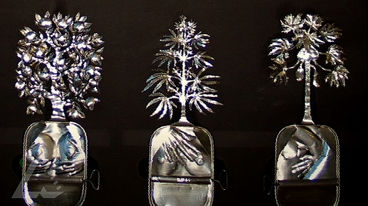
Materiality and transformation are the core elements of her work. Through the use of evocative materials - aluminium, packaging, soap and currency, and images drawn from the environment, Hall explores the boundaries between natural and the man-made, subtly and sometimes ironically reflecting on issues of taxonomy, globalisation, ecology, extinction and natural history. Halls painstaking attention to detail emphasises the beauty and delicacy of the natural world. The fragility with which she handles her medium demonstrates a profound empathy for the susceptibility of living things. Still, her mixing of man-made materials with the forms of nature can be provocative, creating peculiar and politically altered objects that reflect the culture that she is immersed in. This conceptual discord is balanced by her highly appealing aesthetic, which acts as a lure to draw the viewer in to contemplate her message. The disorderly, playfulness and often-sheer peculiarity of Hall's work seduces and fascinates viewers into a labyrinth of continual conundrums.
From Halls whimsical creations that convey a tangible sense of her passion for the beauty and vulnerability of all living things to Cave’s hybrid creations that combine elements of sound performance, colour, and costume to create fanciful works that even the darkest soul would find hard to resist. These artists immerse themselves within their culture and draw inspiration from topics including current global affairs, the natural environment, history and traditional beliefs and values. They manipulate the normality of everyday materials in order to create exquisitely delicate works of art that both intrigue and dare the viewer to find deeper meaning. By creating works of art that contain both social conflicts and historical traditions they create a visual language that reflects society in a witty and sardonic manor.


Comments