Literature from diverse cultures has the potential to further alienate readers...
- Kirsten Sonderer
- Feb 13, 2020
- 9 min read

“If one reads a book claiming that lions are fierce and then encounters a fierce lion, the chances are that one will be encouraged to read more books by that same author, and believe them. A book on how to handle a fierce lion might then cause a series of books to be produced on such subjects as t
he fierceness of lions, the origins of fierceness, and so
forth. A text purporting to contain knowledge about something actual is not easily dismissed. Expertise is attributed to it. The authority of academics, institutions, and governments can accrue to it, surrounding it with still greater prestige than its practical successes warrant. Most important, such texts can create not only knowledge but also the very reality they appear to describe.”
Edward Said describes the life cycle of mind set in a graphic way. “Fictions,” he observes, “have their own logic and their own dialectic of growth or decline.” “Learned texts, media representations and any supposedly authoritative body of knowledge have a self reinforcing. Having gained tendency. Having gained a certain perception from something people have read or heard, audiences come to have expectations that in turn influence what is said or written henceforth.”
Like the notional literature on lions and their fierceness, 9/11 was an event that was capitalized by the western media for political gain. The politicization of scholars, experts and media commentators in the post 9/11 period created a minefield for policymakers and the general public. After 9/11 the words “Muslims” and “terrorists” became synonyms. Muslims were depicted as religious extremists and terrorists with no moral compass.
Readers became ensnarled between the contending positions of seemingly qualified experts as well as a new cadre of Islamophobic authors who engage in an ideological reading of Islam and Islamic history. Former Secretary of State Henry Kissinger, in a 1996 op-ed article criticizing Hollywood director Oliver Stone for distorting history in the movie Nixon, notes that, once put forth in a big-budget movie, "a caricature of history" is virtually impossible to counter in the public mind. Actual history is usually too complex for a simplified dramatic presentation. And so a new body of knowledge is created.
Each scholarly text, each novel and movie and media representation, each piece of data adds to the framework has helps create reality. Culture controls behavior in deep and persisting ways, many of which are outside awareness and therefore beyond conscious control of the individual. “Books are finely tuned machines for transmitting authority and disseminations of cultural capita.”
The physical presence of a text works to deny the elusive, physiological text the reader attempts to construct. A book can either shed a new light on a culture or traps a culture in a malevolent labyrinth of continual name-calling, stereotyping and misrepresentations.
The Brisbane Writers’ Festival has suggested that one way to end divisions that exist between cultures is to encourage people to read literature originating from within other cultures.
However this idea of exposing people to literature in order to achieve cultural acceptance has only alienated readers further. We are constantly bombarded with stories about honor killings, female circumcision, arranged marriages, terrorist bombings and other practices that are repulsive to the Western world. So how are we supposed to accept a culture when all we are presented with is an array of negative behavior?
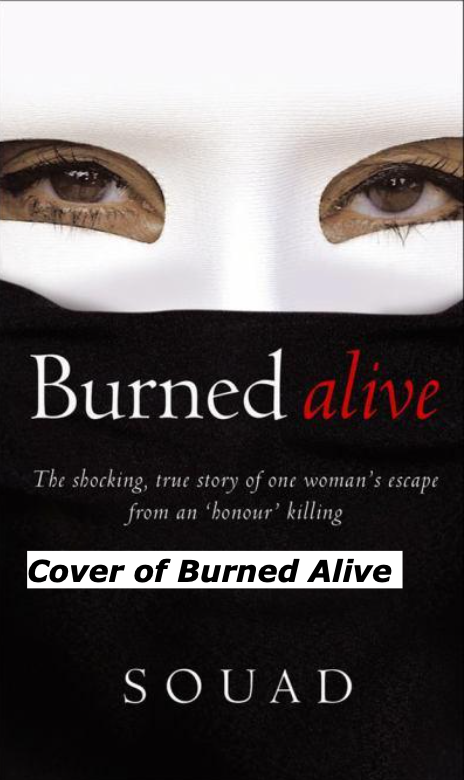
The book entitled Burned Alive is one of the most talked about texts featured at the festival. Burned Alive is a “true” story of Souad, a young Palestinian women who survived an attempted honor killing carried our by her brother-in-law. This autobiography is narrated in such a way that readers can develop a familiarity with the complicated dimension of gender roles, the prevalence of asymmetrical standards of male and female morality in misogynistic societies, and their impact on women. The plot develops in such way designed to inform the reader that honor killing, although outwardly practiced as a customary punishment for illicit sexual relationship, is, in reality, a brutal form of female suppression.
An issue contained in Burned Alive is the lack of self-identity so many people are plagued with. Throughout what Souad deemed her first life - the time between her birth and her attempted murder, it is evident that she never realized she was an actual person; she was simply existing and not really living. She and the other women in her house and village were treated worse than stray dogs. The value of sheep was placed higher than the value of a daughter, who had zero value, which her father constantly reminded her.
“In my village, if men had to choose between a girl and a cow, they would choose the cow. My father repeated endlessly how we girls were good for nothing. A cow produces milk and calves. What do you do with milk and calves? You sell them and bring the money home. But a girl? What does the family get from her? Nothing. A cow and a sheep are more valuable. And we girls know this because the cows and the sheep were never beaten.”
Readers are presented with a representation of a culture that argues that education, and knowledge act like a mirror through which an individual develops an understanding of ”self.” Souad was kept illiterate and her cultural image generated a personal sense of worthlessness, self-incrimination, timidity, impurity, shame, guilt, and potential evilness.
“It’s a curious thing the destiny of Arab women, in my village in any case. We accept it as natural. No thought of rebelling ever occurs to us. We don’t even know what it would mean to revolt. We know how to cry, hide, lie if needed to avoid the stick, but to rebel, never. Quite simply because there’s no other place for us to live than in the house of our father or husband. Living alone is inconceivable.”
This perspective of life is a foreign concept to the Western world. Readers are invited to view these women as second-class citizens. We cannot understand why mothers, sisters and daughters don’t support each other to break free from these behaviors and seek a better life. However, in Souad's culture, the only time a woman could be considered important was if she successfully delivered sons for her husband.
The women were expected and virtually forced to either live a life of extreme obedience, dependence and violence, or be dead to the community (sometimes literally.)
One of the major deeper-level issues is the way people tend to rely on others to define them. They never learn to develop their own personal identity. Souad writes,
My first real meeting with Faiez, in the field of green wheat, gives me for the first time of my existence an idea of who I am."
Readers become alienated by this lack of self identity portrayed in the book. As they cannot accept the idea of self-discrimination and the victim’s inability to stand up and defend oneself. Readers cannot understand the degree of abuse that the women of these families become subject to.
It is tragic that another person’s actions and validation were the only reason Souad even got an inkling of who she was as an individual. How many of us can say that we have spent the time it takes to get to know and embrace ourselves? We are entirely focused on the limited value other people assign us instead of the endless value that is naturally a part of us.
Why is it that we as humans feel we must belong to someone to matter to anyone? All that should matter is the person we are and the person we want to be for ourselves. We should learn to identify with ourselves as individuals and instead of searching for "true love," seek to love ourselves the way we were intended to be and become the people we should be for ourselves and not for others.
There is a cyclical matrimonial behavior, or rather, behaviors learned from one's family, which repeat themselves from generation to generation in a cycle. Throughout the book, Souad documents her father's violent nature. Later, as her brother Assad grows from a boy to a man, he adopts an identical nature.
“He grew into his father's son, a mirror of his brutal, angry self.”
She attributes this to a cycle; Her grandfather taught her father those behaviors, and her father taught her brother those behaviors, and her brother will teach his sons those same behaviors.
This syndrome is not limited to males, either. Souad's own mother allowed two of her daughters to be murdered, one successfully, for no good reason, and even smothered countless female children after birth just because they were female.
While this repulsed Souad, she admits in the book that if she had stayed in her homeland she would be exactly like her mother.
“I would of become normal like my mother, who suffocated her own children, Maybe I would have killed my daughters. I might have let on burn to death. No I think that it is monstrous – but if I stayed there, I would have done the same!”
It's not necessarily that Souad or Assad aspired to be like their mother and father, the reason why this unhealthy cycle exists is because it is all they are taught. Humans learn by example and when growing up the most persistent and consistent example of parenting and appropriate adult behaviors comes from parental figures.
This vicious cycle knows no cultural boundaries; affecting every country, ethnic group, social class, and language group. In America, South Korea, Omen, Kenya, and Switzerland there are sons who beat their mothers and sisters because that’s what their father does. There are daughters who allow themselves to be abused because that’s what their mothers did. It is something so engraved psychologically into people's heads that even if they know
it’s abnormal, it is their only perception of normal.
Readers see this ideology as barbaric, which impacts heavily on the way the in which Muslim men and women are viewed. However exposing young children to literature such as Burned Alive opens the floor to idea that the behavior described in the book may be seen as acceptable.

There was a case in America where young male beat his own sister to death because they got into an argument. He had previously watched a documentary on honor killings.
Unfortunately the western world tends to turn a blind eye as few posses the courage to take a stand against this malevolent display of behavior in these women’s lives.
Burned Alive portrays a patriarchal society dominated by men. Women such as Souad that live in Palestine do not have any rights and live under the control of men. Women are treated as if they are lower than men, and even animals. A family is congratulated if birth is given to a baby boy. On the other hand, if a girl is born it is as if it is a burden and the girl is often times smothered to death.
“Every birth of a girl was like a burial in the family. I remember watching my mother giving birth. There were cries from my mother and then the baby. Very quickly my mother took the sheepskin and smothered the baby. I saw the baby move one and then it was over. I don’t remember what happened after that, just that the bay wasn’t there any more.”
Men decide every detail for the family, including whom his daughters will marry and when, what chores will be done that day and who will do them, and any other decisions that may be made. Women are beaten every day by male members of their family for things as little as being ten minutes late.
“It was not unusual to be beaten or to have our hair shaved and be tied to a stable gate…We lived everyday with the possibility of death. It could come for no reason…simply because Father had decided that you should die.”
Sometimes a man might beat a girl simply because he has had a bad day. Also, it is always a male member of the family that will complete an honor killing. A male member of the family would never be killed for honor, no matter how severe of something he may have done.
Women have no control over what happens in their lives and most have no idea that their life could be any different.
Men seem to think they have the divine right to treat women as chattels and discard them simply because they can. Western readers find it hard to accept these morals, as the idea of men being superior to women is as nonexistent as the idea of pigs flying.
When readers are fed this kind of negative bias against the Middle East, the subliminal cultural consciousness of whole generations is enduringly and profoundly impacted. The “normalcy” of such egregious depictions cogently illustrates what several Western intellectuals qualify at best as acceptable “political correctness” directed against Middle-Easterners. So does exposing people to literature help to break down divisions between cultures?
Burned Alive fits perfectly into the cultural framework created by the media’s stereotyping. Unfortunately, Souad’s life is exactly how we see this culture - a vindictive society that has no respect for women or system of justice.
If this book were to represent this culture they are in no great shape. Perhaps cultural barriers become too convincing. Do we simply accept these portrayals? Or do we climb in between the black marks that litter a page and dare to find a deeper more complex understanding of these cultural divisions?


Comments